
How Net Metering Credits Show Up on Your Bill
Understand how imported and exported units, credits and carry-forward appear on a net-metered electricity bill in Uttar Pradesh after you install solar.

By Rohit Nishad, Co-founder, Surya Udyan
· 7 min read
- Your bill shows units imported from the grid and units exported by your system; you pay for the net amount plus fixed charges.
- Check the bill each month against your inverter's generation figure to confirm that exports are being recorded correctly.
- Carry-forward credit, annual settlement and any meter charge follow regulator rules that can change, so ask your DISCOM for the current terms.
- If a bill looks wrong, collect meter photos, the inverter log and the previous bill before you raise a complaint.
Why the first solar bill looks confusing
Many households are happy for a few weeks after switching on solar, and then the first bill with net metering arrives. It may show lines they have never seen: import units, export units, net units, banked or carried-forward units. Some owners expect a zero bill and feel something has gone wrong when they find a small amount payable. Usually nothing is wrong: the bill follows a simple logic you can check.
This guide explains how to read those lines, how to verify them yourself and what to do when something does not add up. It builds on our introduction to net metering for home owners. Bill layouts differ between DISCOMs and change from time to time, so use this as a general guide and look for the equivalent lines on your own bill.
The numbers in the examples are for illustration only. They are not actual tariffs and not a promise of what your bill will show.
Two readings, not one
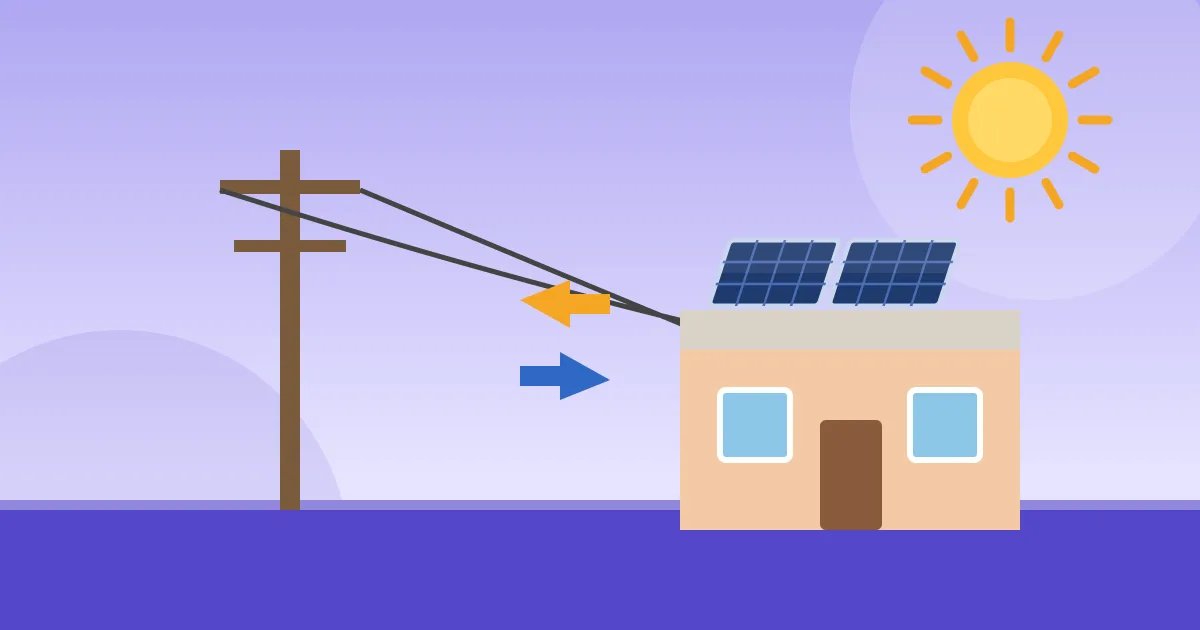
A net meter records two separate counts. Import is the electricity flowing from the grid into your home, which happens at night, on cloudy days and whenever your use is higher than your solar output. Export is the electricity flowing from your home to the grid, which happens when the panels produce more than your home uses at that moment.
This has a practical consequence. The solar energy you use directly in your home during the day never passes through the meter as an import, so it does not appear on the bill at all. Only the surplus is exported and only the shortfall is imported. So the meter's export figure is lower than the units your inverter reports, which is normal.
Your bill may show opening and closing readings for both import and export, and sometimes separate readings for time-of-day blocks if your connection has them. Photograph your meter on the first day of each month if you wish to check the readings yourself.
The lines you are likely to see
Different DISCOMs label things differently, but most net metering bills include the items in the table below. Find each on your bill, and note the units next to it.
| Line on the bill | What it usually means | What to check |
|---|---|---|
| Import units | Energy drawn from the grid in the billing period | Compare with your usual night-time and cloudy-day use |
| Export units | Surplus energy sent to the grid | Should be below inverter generation, because you use some directly |
| Net units | Import minus export, subject to rules | Positive means you pay for them; negative becomes credit |
| Banked or carried-forward units | Credit from earlier months | Opening and closing balance should match the last bill |
| Energy charge | Net units billed at tariff slabs | Check which slabs were applied |
| Fixed charges, duty and taxes | Charges that remain even with low net units | These do not fall to zero |
A worked example with assumed numbers
Suppose in one month your inverter reports that the panels generated 400 units. Your home used 150 of these directly during the day, so 250 units were exported. In the evening and at night you imported 210 units from the grid. Your total home use was therefore 150 plus 210, or 360 units. These are example figures for illustration only.
The meter shows export 250 and import 210. The net is 210 minus 250, which is minus 40, so 40 units are carried forward as credit. Under rules like these, you would pay no energy charge for the month, but you would still pay the fixed charges, duty and any other applicable items, so the bill is small but not zero.
Now consider a month where generation is lower, such as a cloudy monsoon month. Suppose generation is 250 units, of which 120 are used directly and 130 exported, while import is 260. The net is 260 minus 130, which is 130 units, so the bill charges for 130 units, perhaps reduced by the 40 units of credit from before. Credits from sunny months help in cloudy ones this way.
| Item | Sunny month | Cloudy month |
|---|---|---|
| Generated by panels (from inverter) | 400 | 250 |
| Used directly in the home | 150 | 120 |
| Exported to grid | 250 | 130 |
| Imported from grid | 210 | 260 |
| Net units (import minus export) | -40 | 130 |
| Result | 40 units credit carried forward | 130 net units; credit may reduce what you pay |
Why the bill is not zero
Several items stay on the bill even in a good month. Fixed or demand charges depend on your sanctioned load and are billed regardless of units. Electricity duty and certain other charges apply on what is billed. Any month in which you import more than you export leaves net units to pay for. Some DISCOMs also charge a small meter rent or similar item.
Careful installers therefore talk about a much lower bill, not a zero bill. If an installer promised a zero bill without explaining fixed charges, ask them to show an expected post-solar bill with all items included. Our guide to reading your electricity bill before going solar lists these items in more detail.
How carry-forward credit and annual settlement work
When you export more than you import in a cycle, the surplus is generally carried forward to later cycles as credit. This lets the long sunny months of spring and summer support the cloudy and winter months. Credit is usually counted in units, and some arrangements settle it in units while others involve value, depending on the regulator's rules at the time.
At the end of the financial year, rules decide what happens to unused credit. It may be settled at a rate set by the regulator, may be paid out in some form, or may lapse, depending on the rules in force. Do not assume that surplus units are worth the same as the units you buy. Ask your DISCOM, in writing if possible, how your credit is treated, and check the current regulations on the UPERC website. These rules can change, so a neighbour's experience from a few years ago may not apply to you.
Size your system to your own use rather than producing far more than you consume in the hope of income.
How to check your bill every month
A ten-minute check each month catches most problems early. Do it monthly at first, then now and then.
- Note your inverter's total generation for the billing period from its display or app.
- Compare the export units on the bill with that generation; export should be lower than generation.
- Confirm that opening readings match last month's closing readings.
- Check that carry-forward credit equals last month's balance plus this month's surplus, or minus what was used.
- Look at the fixed charges and compare them with the previous bill.
- Keep a simple notebook or sheet with these numbers, month by month.
What to do if the bill looks wrong
Sometimes a meter is not set up correctly, the readings are estimated instead of actual, or credits are not carried forward. If your export units look too low, or your credit disappeared, start by collecting evidence: photographs of the meter display, the last three bills and the inverter log for the period. Then speak to your installer, who can often confirm whether the system is working properly.
If the issue lies with the meter or billing, contact the sub-division office or the DISCOM's customer care with your account number and the evidence. Ask for a complaint number and note the date. If the matter is not resolved, there are escalation routes through the DISCOM's grievance process and the consumer grievance redressal forums. Stick to facts and keep copies of every document.
If you need help understanding your solar bill, contact us through the form on our home page.
FAQ
- Why is my bill not zero after solar?
- Fixed charges, duty, taxes and any net units imported can remain even when your solar exports units during the day.
- What if I export more than I import?
- The extra is generally carried forward as credit under the DISCOM rules. Treatment of unused annual credit is set by the regulator, so ask for the current rule.
- Where can I see my generation?
- Your inverter shows units generated, while the net meter records imports and exports for billing. Compare both when you check a bill.
- Why is export on my bill less than my inverter's generation?
- Because you use part of the solar energy directly in your home. Only the surplus is exported and recorded by the meter.
- Who do I call if my credits are missing?
- Start with your installer to confirm the system is working, then contact your sub-division office or DISCOM customer care with meter photos, bills and the inverter log.
Sources and official links
Figures in this article are general and may change. See our disclaimer, or contact us for a quotation specific to your site.