
Net Metering Explained: How Your Roof Can Lower Your Bill
What net metering is, how exported units are adjusted against your bill, and what to expect when you apply with your DISCOM in Uttar Pradesh.

By Rohit Nishad, Co-founder, Surya Udyan
· 7 min read
- Net metering offsets the units you export against the units you draw, so you pay for the net amount plus fixed charges.
- You do not need batteries to benefit, because daytime surplus offsets evening use through the grid.
- Ask how credits are carried forward, how unused credit is treated at year end and whether any meter charge applies.
- Never switch on a grid-connected system before the DISCOM inspects it and installs the net meter.
The basic idea in plain words
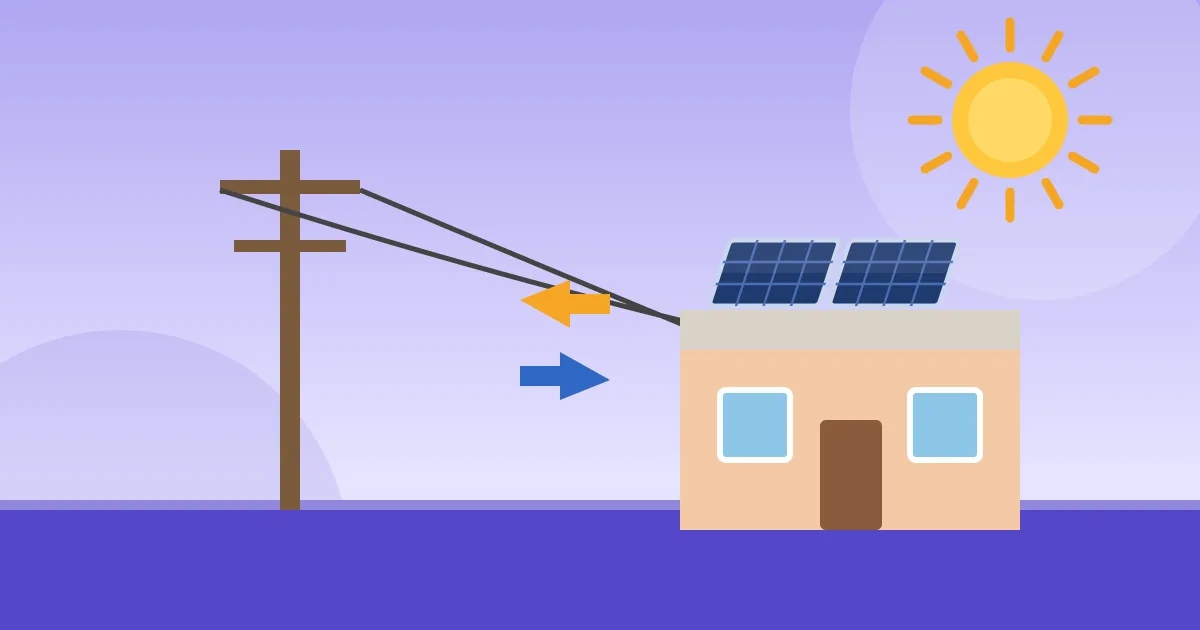
Think of the electricity grid as a shared bank for power. In the day, your rooftop panels often make more electricity than your home uses, so the extra flows out to the grid. In the evening and at night, when the panels are idle, you draw power back from the grid. A net meter keeps count of both flows. At the end of the billing cycle, the DISCOM looks at the difference and charges you only for the net units, along with fixed charges and duty.
In effect, the home uses the grid as storage, without the cost and upkeep of batteries. Most rooftop systems in towns and cities in Uttar Pradesh are grid-connected for this reason, which makes net metering an important step in a solar project.
This article is general information for home owners. Rules on settlement, banking of units, charges and limits are decided by the regulator and implemented by the DISCOM, and they can change. Check current terms with your DISCOM before you decide.
How the meter works
A normal electricity meter only counts the power coming into your home, and some older meters may even run backwards or misread if power flows out. A net meter, which is bi-directional, measures import (power from the grid to you) and export (power from you to the grid) separately. Many are digital and can store both readings along with time of day.
Since it records both flows, a net meter lets the DISCOM bill you for the difference. The meter is typically supplied or approved by the DISCOM, tested, sealed and installed by its staff, so that the readings can be trusted by both sides. A meter that is not approved cannot be used for billing exports.
A simple monthly example
Suppose a home uses 320 units in a month, and its solar system exports 180 units to the grid during the day while it imports 140 units in the evening. The example numbers below are for illustration only.
In many net metering arrangements, what matters is the balance between import and export. In this example the home imported 140 units and exported 180, so the net is minus 40 units. Instead of being billed for units, the home would typically carry forward 40 units as credit to the next billing cycle, and would still pay fixed charges, duty and other applicable items on the bill.
| Item | Units | What it means |
|---|---|---|
| Imported from grid | 140 | Evening and night use |
| Exported to grid | 180 | Daytime surplus from solar |
| Net (imported minus exported) | -40 | You have 40 units of credit |
| Billed energy charge | 0 units | Credit is carried forward, subject to rules |
| Fixed charges and duty | Still apply | These do not fall to zero |
Why you do not need batteries
Many people think rooftop solar always needs batteries. Most homes in towns with fairly reliable supply do not need them. Batteries are costly, wear out in a few years and need space and care. Net metering lets you use the grid in place of a battery, because the surplus you export during the day is credited against what you draw later.
Batteries make sense when you need backup during outages, or when there is no grid or no net metering available. Even then, many homes choose a hybrid design that keeps net metering for savings and uses a small battery for essential loads. Our article on on-grid, off-grid and hybrid solar explains how to decide.
How to get a net meter
The process in Uttar Pradesh follows a standard path, though names of portals and forms may change. First, your installer or you submit an application to the DISCOM along with documents, typically a recent electricity bill, identity proof, details of the system and proof of ownership or permission for the roof. Next, the DISCOM checks feasibility. After installation, an inspection is carried out, the net meter is installed and the system is allowed to start.
Your installer commonly handles the paperwork, but you are the applicant, so keep copies. Ask for the application number, track progress and note the expected dates. Our detailed net metering application checklist for Uttar Pradesh lists documents and steps, and the PM Surya Ghar portal has a combined process for subsidy households.
- Keep your latest bill, ID, roof permission and system details ready.
- Ask for the application number and track it on the portal or with the sub-division office.
- Do not switch on the grid-connected system until approval and meter installation are complete.
- Keep the commissioning certificate and meter details in one file.
What to ask about settlement and credits
Ask your DISCOM or installer how units are settled: monthly, annually or at the end of the financial year. Ask what happens to credits that are still unused at the end of the period, and at what rate any leftover credit may be paid or lapsed. These rules are set by the regulator and may have changed from what a friend or neighbour tells you.
Also ask whether the billing is by net units or by value, how time-of-day tariffs, if any, affect the result, and whether any one-time or monthly charge applies for the net meter. A good installer puts the answers in writing and explains how they affect your savings. Our guide on how credits appear on your electricity bill shows how this looks in practice.
Limits and capacity rules
There are limits on system size relative to your sanctioned load, and the DISCOM may also consider transformer capacity in your area. Households commonly find that net metering is allowed up to their sanctioned load, with a cap that depends on the current rules. If your desired system is bigger than your sanctioned load, a load enhancement may be needed.
Do not oversize in the expectation of earning from large exports. Settlement rules usually give credit that offsets future bills, and any payment for surplus at year end is typically at a rate decided by the regulator, which may be lower than what you pay per unit. Size the system to your own use.
Power cuts and the net meter
Many new owners are surprised that a standard grid-connected system stops producing when the grid goes down. This is a safety feature called anti-islanding, which protects line workers from live wires. Net metering does not change this. If you want power during a cut, you need a hybrid inverter and battery, or a separate backup arrangement.
When the grid returns, the inverter waits for a short time to confirm stable supply and then reconnects automatically. If it does not restart, check the display for a fault code, and call the installer.
Common mistakes to avoid
A few errors cause most net metering delays.
- Switching on before inspection and meter installation, which is unsafe and may be penalised.
- Not checking sanctioned load before choosing system size.
- Having unpaid dues on the connection, which can hold up approval.
- Assuming the bill will be zero, forgetting fixed charges and duty.
- Not keeping copies of the application, approval and commissioning papers.
- Believing claims about selling power at retail rates without checking the rules in writing.
FAQ
- Who applies for net metering?
- Your installer normally files the application with the DISCOM, but you are the applicant, so ask for the application number so you can track it.
- Do I pay for the net meter?
- Meter charges depend on DISCOM rules. Ask for the charge in your written quotation.
- What if I export more than I use?
- Surplus is carried forward as credit under DISCOM rules, and the treatment of unused annual credit is set by the regulator. Ask for the current rule in writing.
- Do I need a battery if I have net metering?
- Not for savings. A battery is only needed if you want power during outages, because a standard grid-connected system shuts down when the grid fails.
- Can I switch on my solar system before the net meter is installed?
- No. A grid-connected system should only be switched on after inspection, approval and installation of the net meter.
Sources and official links
Figures in this article are general and may change. See our disclaimer, or contact us for a quotation specific to your site.