
PM-KUSUM Scheme for Farmers: A Simple Overview
A plain overview of the PM-KUSUM scheme for solar pumps and farm solar plants, what it covers and how to check current rules in Uttar Pradesh.
By Rohit Nishad, Co-founder, Surya Udyan
· 8 min read
- PM-KUSUM supports farmers with solar pumps, solarisation of grid pumps and small solar plants on farm land, under separate components.
- Eligibility, subsidy shares and application procedures are set by the central and state governments and can change, including the scheme's own validity period.
- Pick the component that matches your situation: no grid, a grid pump, or spare land.
- Always confirm current rules with the MNRE portal or your state nodal agency before you pay anyone.
What PM-KUSUM is
PM-KUSUM stands for Pradhan Mantri Kisan Urja Suraksha evam Utthaan Mahabhiyan. It is a central government scheme, run through the Ministry of New and Renewable Energy (MNRE), that aims to help farmers use solar power for irrigation and as a source of extra income. The scheme has been in place since 2019 and has been implemented through state agencies, which in Uttar Pradesh means the state's nodal agency for renewable energy.
For many farmers in districts like Basti, Sant Kabir Nagar, Siddharthnagar and Gorakhpur, irrigation is the largest use of power or diesel on the farm. Diesel pumps are costly to run and noisy, and grid supply to agricultural connections can be limited to certain hours. Solar pumps use sunlight during the day, which is also when crops need water, and they have low running cost once installed.
This article is a general overview and not an application guide. Scheme guidelines, subsidy shares, validity dates and procedures are revised by the government from time to time. Treat everything here as background and confirm details on official sources.
The three components in plain language
PM-KUSUM is organised into components, often called A, B and C. Each is meant for a different kind of beneficiary. Start by finding which one applies to you, since the paperwork, subsidy and benefits differ for each.
| Component | What it covers | Who it suits |
|---|---|---|
| Component A | Small decentralised solar plants, typically up to a few megawatts, on barren or farm land, with power sold to the DISCOM | Landowners, farmers' groups, cooperatives and developers with suitable land near a substation |
| Component B | Standalone solar pumps replacing diesel or enabling irrigation where no grid connection exists | Farmers without a grid-connected pump |
| Component C | Solarisation of existing grid-connected agricultural pumps, including individual pumps and feeders | Farmers who already have a grid pump connection |
Component B: standalone solar pumps
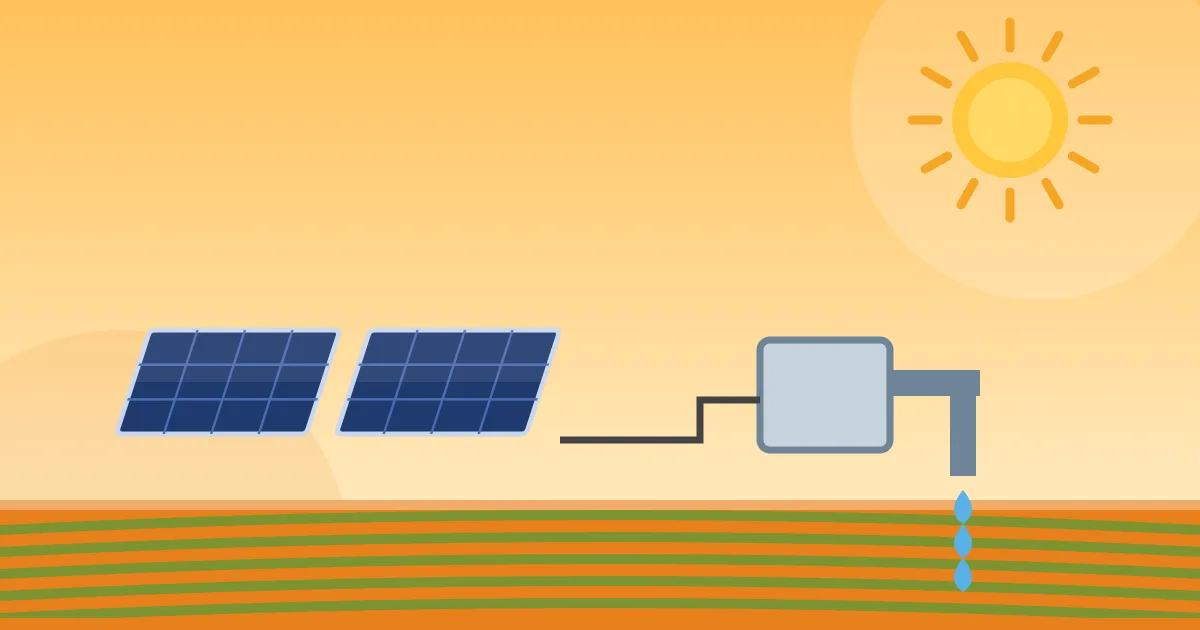
A standalone solar pump system has panels, a pump controller and a pump, usually without a battery. Water is pumped when the sun shines and can be stored in a tank or pond for use later. It works best when the farmer has a borewell or open well and wants to cut diesel costs or end dependence on irregular supply.
Under the scheme guidelines, support has historically come as a central financial assistance share, a state share and the farmer's own contribution, and capacity is limited to a range of pump sizes. The exact percentages, pump capacities, approved equipment lists and priority rules can differ between states and between years. Ask your nodal agency or district agriculture office for the current list of eligible pumps and the rate chart.
Before applying, note the depth of your water source, how much water you need per day and your land size. A pump that is too small will not irrigate enough, and one that is too large wastes the subsidy and may over-draw groundwater. Our article on how a solar water pump works explains sizing in simple terms.
- Check the water level and yield of your borewell before choosing a pump size.
- Choose a model from the approved list for the current scheme year.
- Ask for the exact cost split between subsidy, your contribution and any loan.
- Keep the installation certificate and warranty papers safe.
Component C: solarising a grid pump
Many farmers already have a grid-connected agricultural pump. Component C allows such a pump to be powered by solar panels, so that daytime irrigation comes from the sun and the farmer may be able to feed surplus power to the grid, depending on how the state implements it. This can turn a pump from a cost into a small income source.
The details differ widely. Some states promote feeder-level solarisation, where a whole agricultural feeder is powered by a solar plant. Others support individual pumps. The approach, the payment for surplus power and the effect on your tariff depend on state policy and your DISCOM. Ask the nodal agency whether your feeder or village is covered at present.
If you are considering this, also read our overview of net metering, because grid-connected systems follow technical and billing rules set by the regulator.
Component A: small solar plants on land
Component A is meant for people with land who want to set up a small solar power plant and sell power to the local DISCOM under a long-term agreement. It suits landowners, farmer groups, cooperatives and panchayats who have suitable land close to a substation. It is closer to a small business than to a farm subsidy, because it involves land lease or ownership, permissions, a power purchase agreement and a significant investment.
Agents often approach landowners with large promises about rent or income. Verify with the nodal agency and the DISCOM whether your land and location qualify, what the tariff and agreement terms are, and what the developer's financial and technical standing is. Do not sign land documents or pay fees on verbal promises. Our article on ground-mounted solar basics for landowners explains what to check.
How a typical application works
Procedures vary by state, but the general path is similar. You register on the state nodal agency portal or on the national portal, submit your land and identity documents, choose your component, pay your share and wait for allotment or approval. After approval, an empanelled vendor installs the system, and an inspection confirms completion before subsidy is released to the vendor or to you, depending on the model.
Documents commonly asked for include an identity proof, proof of land ownership or tenancy, bank account details, a recent photograph and in some cases a bank letter or no-objection documents. Check the list on the official portal, because it can change. Never pay anyone who claims to guarantee approval, and note that application fees, if any, are published on the official portal.
- Register only on official portals or through the state nodal agency's offices.
- Keep copies of all forms, receipts and acknowledgments.
- Use only vendors that are empanelled by the agency for the current year.
- Ask for a written delivery and installation timeline.
- Inspect the system on installation day and match the serial numbers to the documents.
Subsidy shares and why you must verify them
In the original design of the scheme, the cost of a standalone pump or a grid pump solarisation was shared between the central government, the state government and the farmer, often with a bank loan option for part of the farmer's share. These ratios, the caps per farmer and the capacity limits were set in the scheme guidelines and have been adjusted over time.
Because they can change, this article does not give a rupee figure. Ask the nodal agency for the current rate chart. If a vendor gives you a very specific subsidy amount, ask them to show the notification or portal page it comes from. If the amount cannot be confirmed, do not pay in advance on that basis.
Also confirm the scheme's validity. Government schemes have fixed periods, and extensions or successor schemes are announced separately. The MNRE website carries the current status.
Avoiding fraud and weak installations
Government schemes attract middlemen. Some collect advance money and promise quick approval, and some supply poor quality equipment. Use official channels, pay by traceable methods, ask for a receipt on every payment and make sure the equipment is on the approved list for the scheme year.
Check what the warranty covers and who will repair the pump if it fails. A solar pump is a long-term asset, so local service matters. Ask for a service contact in your district and keep it. Also make sure that the panels are mounted securely, since field structures face wind, animals and theft, and that the controller and wiring are protected from water.
Where to check current information
The most reliable places are the MNRE website, the PM-KUSUM national portal and your state nodal agency, which in Uttar Pradesh is the renewable energy development agency. District agriculture offices and block offices also have local information. A trustworthy installer shows you the exact guideline page and welcomes your checking it.
To discuss solar for irrigation or your farm connection, use the quotation form on our home page. We will explain what applies to your situation, and we do not promise approvals or subsidies that depend on the government.
FAQ
- What is PM-KUSUM?
- It is a central government scheme that supports solar for farmers, including solar pumps, solarisation of grid pumps and solar plants on farmland. Details are on the official MNRE site.
- Who can apply for a solar pump?
- Eligibility depends on the state and the component of the scheme. Check with your state nodal agency for the current rules and approved equipment list.
- Is the subsidy the same in every state?
- No. State governments implement the scheme and may add their own support, so amounts and procedures differ.
- Can I use PM-KUSUM for my existing electric borewell?
- Possibly, under the component for solarising grid-connected pumps, if your state and feeder are covered. Ask the nodal agency whether it is available now.
- Should I pay an agent to get approval?
- No. Apply through official portals or the nodal agency, keep receipts, and be wary of anyone guaranteeing approval or asking for advance cash.
Sources and official links
Figures in this article are general and may change. See our disclaimer, or contact us for a quotation specific to your site.