
Solar Water Pump for Farmers: How It Works
A plain explanation of how a solar water pump works, how to size it for your borewell and field, and what to check before you buy in Uttar Pradesh.

By Rohit Nishad, Co-founder, Surya Udyan
· 8 min read
- A solar pump runs directly from panels during the day and needs no diesel or grid power, so running cost is very low.
- Pump size depends on water depth, total lift, daily water need and available sunlight hours.
- Storing water in a tank or pond is usually cheaper and simpler than storing power in batteries.
- Check water source yield, equipment warranty, dry-run protection and local service before you buy.
How a solar pump works
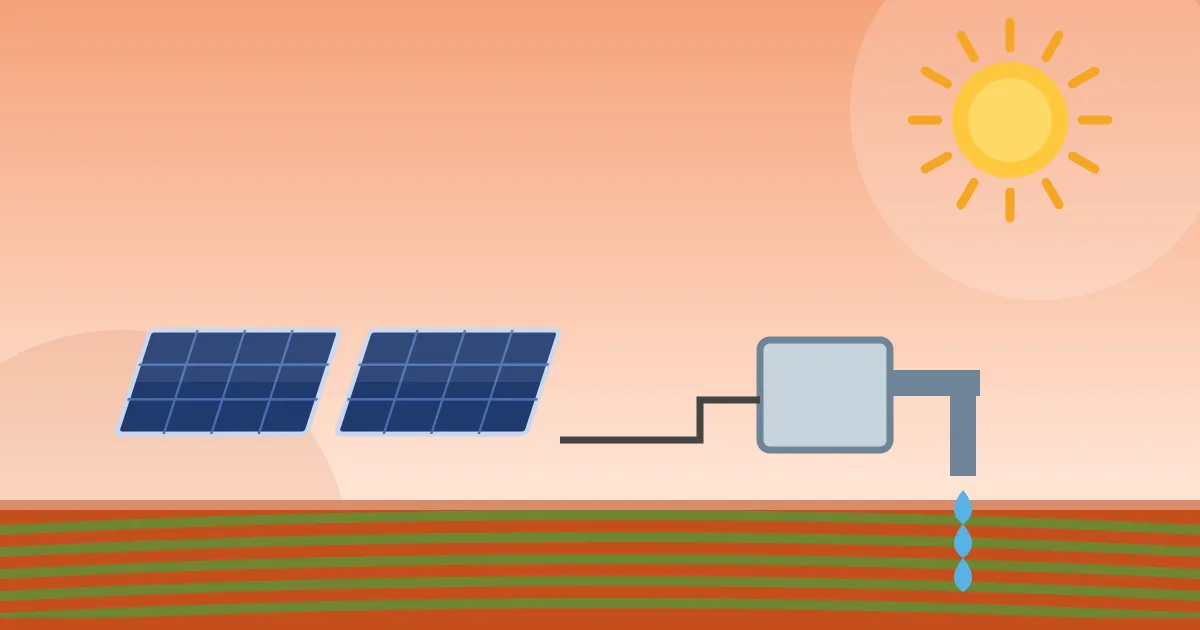
A solar water pump system has three main parts: solar panels, a controller and a pump. The panels turn sunlight into electricity. The controller takes that electricity and drives the pump motor, adjusting its speed to match the sun. The pump lifts water from a borewell, open well, pond or canal and delivers it to a tank or field.
Because there is no engine and no fuel, the running cost is very low. In the morning the pump starts slowly as sunlight builds, runs at full speed around midday and slows in the evening. On a cloudy day it pumps less water. That is normal for a system that runs directly on sunlight.
This guide is general information for farmers. Actual sizing, equipment and cost depend on your water source, land and crops, so a visit by a qualified technician is essential before you buy.
DC pumps, AC pumps and the controller
Solar pumps come in two main kinds. A DC pump runs directly on direct current from the panels, and is often used for smaller capacities. An AC pump runs on alternating current and needs a solar pump controller, sometimes called a variable frequency drive (VFD), which converts panel power and adjusts the motor speed. Larger pumps, such as those of several horsepower, commonly use AC motors with a solar VFD.
A good controller does more than run the motor. It tracks the best operating point of the panels, protects the pump from dry running when the water level drops, guards against over-voltage and over-current and can stop the pump when a float switch shows the tank is full. These protections matter, because a pump that runs dry can burn out in a short time. Ask for the protection features in writing.
Some systems can also work with the grid or a generator as a backup source, through a hybrid controller. That adds cost but gives the option to irrigate on cloudy days or at night in an emergency. Ask whether it is available and whether the cost is worth it for your crops.
Sizing the pump: depth, lift and daily water
Size is the most important decision. A pump that is too small leaves crops short of water, and one that is too large wastes money and may over-draw a borewell. The installer needs several facts: the depth of the water level, including how it falls in summer, the total height the water must be lifted including to a tank, the length and diameter of pipe, the daily water requirement and the sunlight available on your site.
Farmers often describe pumps in horsepower, such as 3 HP or 5 HP, but the same horsepower gives different water output at different depths. A pump delivering plenty of water from a shallow well may deliver much less from a deep borewell. That is why the manufacturer's performance chart, which shows litres per day at different heads, is more useful than horsepower alone. Ask for the chart for the exact model.
The water you need each day depends on crop, soil, season and method of irrigation. Drip and sprinkler methods use less water than flood irrigation. If you are planning to switch to drip, a smaller pump may be enough. Our related article on the PM-KUSUM scheme describes the subsidy component for pumps.
| Item | Why it matters | How to find it |
|---|---|---|
| Water source and yield | A borewell that gives little water cannot support a large pump | Past pump records, well owner, local driller |
| Water level (static and in summer) | Deeper water needs more power per litre | Measure or ask the borewell driller |
| Total lift and pipe length | Higher lift and longer pipes need a stronger pump | Measure from water to tank outlet |
| Daily water need | Sets the pump's daily output target | Crop area, crop type and irrigation method |
| Sunlight and shade | Shade on panels reduces pumping | Check the panel site through the day |
Store water, not power
Solar energy is available only in daytime, but crops can wait for water. The simplest way to handle this is to pump into a tank, pond or farm reservoir during sunny hours and let the water flow to the field later by gravity or by a small drip system. Water storage is cheaper than batteries, lasts longer and needs less care.
A tank sized for one or two days of requirement gives a buffer on cloudy days. If your field is lower than the tank, gravity may feed irrigation without any extra pump. If you are using a pond, check for seepage and evaporation losses, which can be large in summer. Lining or covering a pond may be worth the cost in some farms.
Batteries are rarely used with farm pumps because they are costly and wear out in a few years. They may make sense for a specific need, such as night-time pumping for livestock, so choose them only for a clear need.
Panel capacity, mounting and placement
The panel capacity needed is usually somewhat higher than the motor's rated power, to allow for losses and for sunlight that is less than perfect. Your installer will specify the panel wattage and the number of panels for your chosen pump, and will explain whether the pump will run at full speed in the early morning and late afternoon.
Placement matters. Panels should face south with a tilt suited to your latitude, and should not be shaded by trees, buildings or the tank. They should be mounted on a strong structure fixed in concrete foundation, with a design that can resist wind. Farms face gusty storms before monsoon, and a weak structure can topple. Some farms use a tracker that follows the sun, which can raise water output but adds cost and moving parts that need maintenance.
Theft and damage by animals are real concerns. Consider fencing, anti-theft fasteners and a secure position close to the house or a watched area. Ask about insurance for the equipment, and check whether your village has had incidents.
- Keep panels shade-free from about 9 am to 4 pm.
- Use a foundation and structure designed for local wind.
- Fix panels with anti-theft fasteners and consider fencing the site.
- Keep the controller in a protected box away from rain and animals.
Cost, running cost and subsidy
A solar pump costs more at the start than a diesel pump, but its running cost is very low, with no fuel, little maintenance and no electricity bill for the pump. Over several seasons, the money saved on diesel or grid power can repay the investment. How long that takes depends on how many hours you pump, the price of diesel, the system cost and the subsidy. Our payback guide explains the method with an example.
Government schemes, mainly PM-KUSUM, have supported solar pumps through central and state financial assistance, but eligibility, amounts and procedures differ between states and change over time. Check the current position with your state nodal agency or the official portal before you plan around a subsidy, and do not pay advance money to anyone on the promise of approval.
Maintenance and common faults
A few habits keep a solar pump healthy. Clean the panels regularly with soft water. Check the structure bolts and wiring now and then, especially after a storm. Watch the water level, because a falling level means the pump may run dry. Use the controller's dry-run protection and do not bypass it.
If the pump delivers less water than before, first check the panels for dirt or shade, then the pipes for leaks or blockages, then the borewell level, and then call the service contact. Keep a record of the date you cleaned and the water delivered. It helps in diagnosing a fault and in warranty claims.
- Clean panels every few weeks, more often in dusty seasons.
- Check for loose bolts, damaged cables and rodent damage after storms.
- Never run the pump dry, and keep the dry-run sensor connected.
- Keep the warranty card, serial numbers and service number in a safe place.
What to check before you buy
Ask for the brand and model of the pump, motor, controller and panels, along with the performance chart and warranty terms. Confirm that dry-run protection and over-voltage protection are included. Ask who will install, who will repair and how quickly they will respond in your village, since a pump failure during irrigation season is costly.
Compare at least two proposals on equipment quality and after-sales service as well as price. If you plan to use a government scheme, check that the model is on the approved list for the current year. If you are also considering solar for a flour mill or a grid-connected connection, read our related articles on atta chakki and VFD systems. You can also use the quotation form on our home page to talk to us.
FAQ
- Does a solar pump work without batteries?
- Yes. Most solar pumps run straight from the panels and pump more water when the sun is strong, so a storage tank is used for later.
- How do I choose the pump size?
- Your installer needs the water source depth, the total height the water must lift, your daily water requirement and the crop schedule. Ask for the manufacturer's performance chart.
- Is there a subsidy for solar pumps?
- Schemes such as PM-KUSUM have solar pump components, but eligibility and amounts change. Check the current rules with the official portal or your state agency.
- What happens on a cloudy day?
- The pump runs slower or delivers less water. A storage tank gives a buffer, and some systems can switch to a grid or generator backup if you choose that option.
- Can a solar pump run at night?
- Not without a battery or another source. Most farmers pump in daytime and store water in a tank for later use.
Sources and official links
Figures in this article are general and may change. See our disclaimer, or contact us for a quotation specific to your site.